Team dynamics: map your team's strengths and blind spots
By Dennis Kriel ·
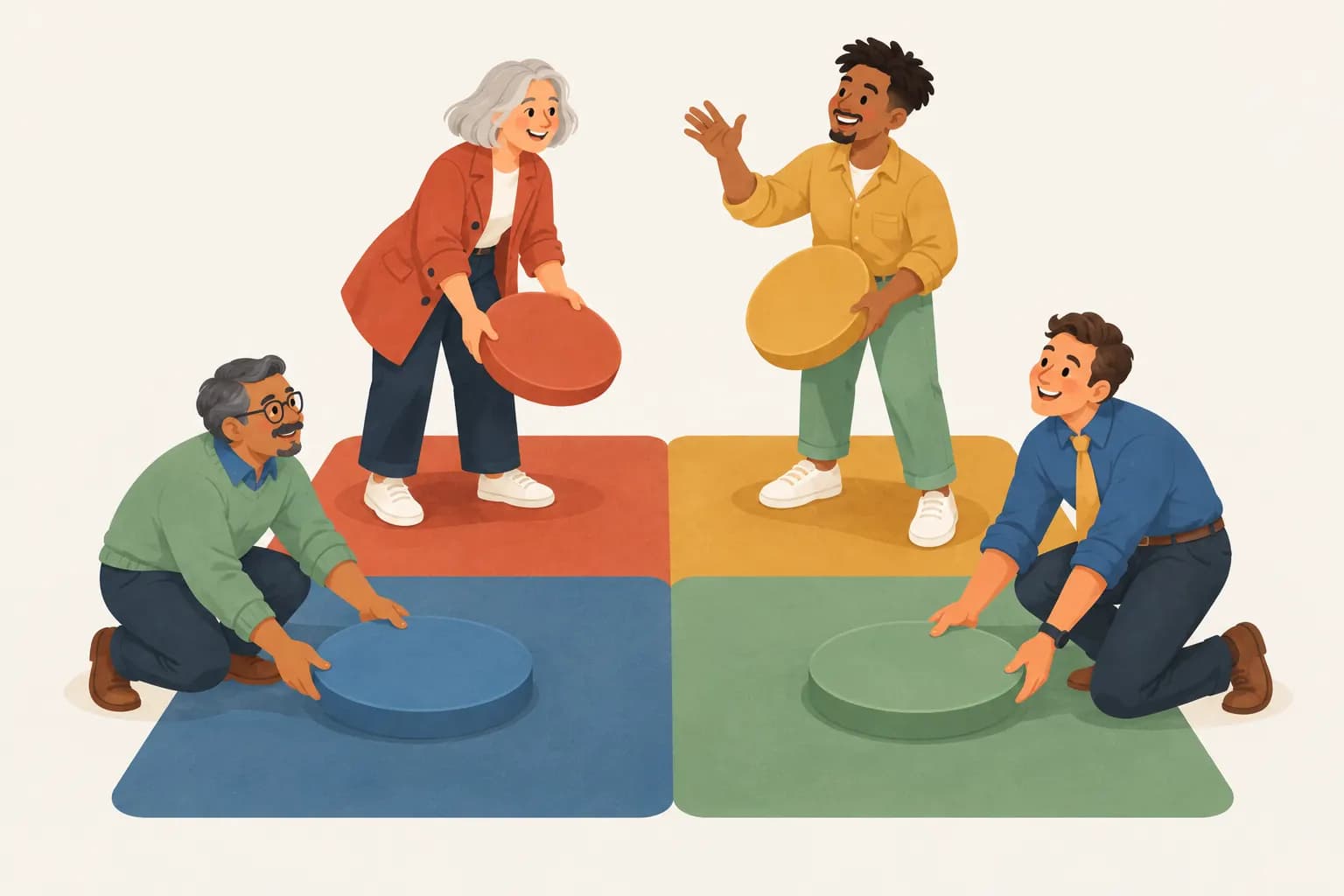
Team dynamics are the unwritten patterns in how a team works together: who speaks first, how decisions get made, what happens when people disagree and what quietly gets dropped. A big part of those patterns comes from the mix of personalities in the team. When you can see that mix in terms of the four DISC styles, you can see your team's strengths and blind spots, and fix the gaps before they cost you.
What team dynamics really are
Every team has two sets of rules. The written ones are the job descriptions, the meetings and the processes. The unwritten ones are the team dynamics: whether people raise problems early or late, whether meetings end with decisions, whether the quiet person's idea ever gets heard.
Good dynamics are not about everyone getting along all the time. They are about the team using what each person brings. A team with healthy dynamics argues about ideas, decides, follows through and still likes each other at the year-end function.
Dynamics are shaped by many things, including workload, leadership, history and trust. Personality style is one of the easiest to see and talk about, because it gives people neutral words for differences that otherwise feel personal.
How the mix of styles shapes a team
Each DISC style brings something a team needs. Problems start when one kind of contribution is missing, or when one style is so strong that it drowns out the others.
Most people are a blend, so a real team rarely splits neatly into four. A Protective Leader brings Direct drive with Steady care, and an Encourager brings Inspiring energy with Steady loyalty. Look at the overall lean of the team, not just the labels.
- Direct people bring pace, decisions and a focus on results. They push the team to act.
- Inspiring people bring energy, ideas and connection. They keep morale up and sell the team's work to others.
- Steady people bring reliability, patience and care. They notice who is struggling and keep things running.
- Careful people bring quality, planning and an eye for risk. They catch the mistakes before the client does.
Signs your team leans too far one way
Team strengths and weaknesses usually come from the same source. A team that leans heavily towards one or two styles gets those styles' strengths in abundance, and their blind spots too. These are the patterns to watch for.
Read the list with a specific week in mind. If three or more signs in one group sound familiar, you have probably found your team's lean.
- All Direct, no Careful: fast decisions and plenty of momentum, but rework, missed details and "we'll fix it later" that never gets fixed. Quieter people stop speaking up.
- All Inspiring, no Steady: great brainstorms, exciting launches and a lot of half-finished projects. Everyone loves the kick-off meeting; nobody owns the follow-up.
- All Steady, no Direct: a kind, loyal team that avoids conflict. Problems get worked around rather than raised, change feels threatening and decisions wait for a consensus that never quite arrives.
- All Careful, no Inspiring: high-quality work that nobody else hears about. Meetings feel flat, ideas get picked apart before they grow, and the team can seem distant to the rest of the business.
- Fast styles versus measured styles: a team split down the middle often argues about pace rather than substance. One side feels held back; the other feels steamrollered.
A simple exercise to map your team
You can map your team's dynamics in about 45 minutes with a whiteboard or a big sheet of paper. It works best after everyone has taken the free DISC Test, but you can also run it on people's own sense of their style.
Keep it light and voluntary. People choose what they share, and the point is to understand the team, not to label anyone.
- Draw a big square split into four: Direct top left, Inspiring top right, Steady bottom right and Careful bottom left. The top half is faster-paced, the bottom half more measured.
- Ask everyone to place a sticky note with their name where their style sits. Blends go near the line between two styles.
- Step back and ask: "Where are we crowded, and where are we empty?"
- For the empty corner, ask: "What does that style usually bring, and who covers it for us now?"
- For the crowded corner, ask: "What does that style tend to miss, and when has that bitten us?"
- Pick one or two habits to borrow from the missing style, such as a risk check before every launch or a two-minute round of "who hasn't spoken yet?"
- Take a photo of the map and look at it again in three months.
What to do with your map
A gap in your map is not a hiring brief. DISC describes preferences, not ability, and it should never be used to choose, promote or exclude people. Every style can learn to do what the missing style does naturally. It just takes a bit more effort and a shared agreement to do it.
Most gaps can be filled with small, deliberate habits. A team without Careful energy can add a checklist and a "what could go wrong?" question to every plan. A team without Direct energy can set deadlines for decisions. A team without Steady energy can check in on workload each week, and a team without Inspiring energy can make a point of celebrating wins out loud.
If you are about to run a review at the end of the year, our year-end team review questions pair well with this exercise, and icebreaker questions for work can warm the room up first. For more ideas, browse the teams topic page.
See your team's map live
Drawing the map by hand is a good start. The DISC Test team pack goes further: up to 15 people each get a Full Playbook, the team gets a live team map showing where you lean and what you might be missing, and you can see pair reports between members. It costs US$249 a year, and members choose what they share.
Map your team
See where your team leans, what it might be missing, and compare any two colleagues.
DISC for teamsQuestions people ask
What are team dynamics?
Team dynamics are the unwritten patterns in how a team works: how it communicates, decides, handles disagreement and follows through. They are shaped by workload, leadership, trust and the mix of personalities.
What are examples of poor team dynamics?
Common examples are meetings dominated by one or two voices, problems raised too late, decisions that keep getting reopened and work that starts well but is never finished. These often point to a team leaning too far towards one style.
How do you improve team dynamics?
Start by making the patterns visible, for example by mapping the team's styles together. Then agree one or two small habits that cover the team's blind spots, and check in on them after a few months.
Should you build a team by DISC style?
No. DISC should never be used for hiring or selection. Any team can cover its blind spots by understanding its mix and agreeing habits that bring in what is missing.
Read more about the Direct, Inspiring, Steady and Careful styles.
Related profiles


More guides

Leadership styles: how each DISC style leads, and how to lead people unlike you
How Direct, Inspiring, Steady and Careful leaders lead, the strengths and blind spots of each, and practical ways to lead people whose style differs from yours.

Icebreaker questions for work: 44 team building questions that get people talking
44 icebreaker questions for work and team building, grouped by purpose: quick warm-ups, working styles, deeper team questions and remote meetings.

Decision-making styles: how each DISC style decides, and how to decide together
How Direct, Inspiring, Steady and Careful people make decisions, the best-known decision-making style models, and how a mixed team can decide together.